
Purchase Order Template
Fill in a purchase order in your browser — your company, the vendor, shipping details and line items — and the totals calculate as you type. Print it, save it as a PDF from the print dialog, or download the line items as CSV.
- Free to use
- No sign-up
- Runs in your browser
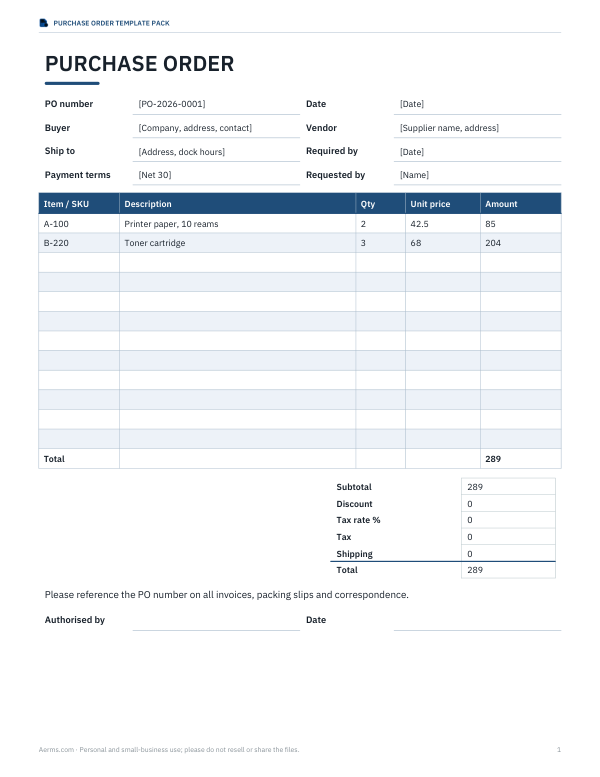
Create a purchase order
| Item / SKU | Description | Qty | Unit price | Amount |
|---|
USD only. Line amounts round to cents, then tax is estimated on subtotal minus discount; shipping is added after tax. Confirm applicable tax treatment separately. Blank lines are ignored; partially completed lines must be fixed. Up to 200 lines.
Purchase Order Template Pack
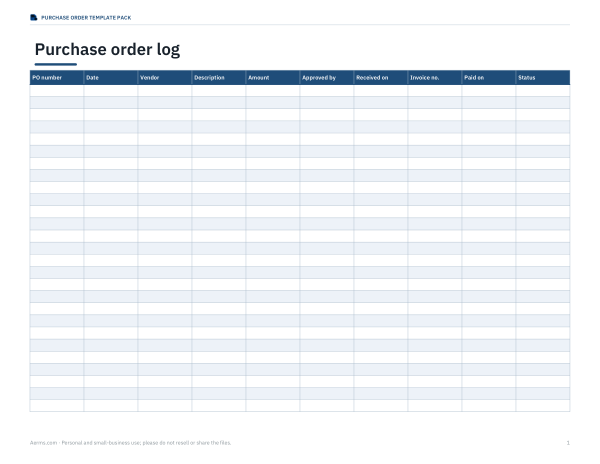
6 files: 2 free PDFs, 1 editable Word form, 2 Excel workbooks and README. The $5 ZIP adds editable files; automatic arithmetic is in Excel only. Word and PDF amounts must be updated manually. No vendor database or approval automation.
- Purchase order (XLSX, DOCX, PDF)
- PO log & receiving record (XLSX, PDF)
Formats: XLSX, DOCX, PDF. Instant download after payment (link valid 72 hours, up to 5 downloads). AI-assisted: the templates were drafted with AI help and reviewed and laid out before publishing.
$5.00 USD, one-time
- Instant download
- 7-day refund
- Secure checkout by Stripe
7-day money-back guarantee. Full refund within 7 days of purchase, even after you download.
Full refund within 7 days — see the refund policy and license.
Free printables
Single sheets you can print right now, no sign-up. The full pack adds every sheet in one download plus the editable files.
What a purchase order is
A purchase order (PO) is a document a buyer sends to a supplier to order goods or services. It lists what is being bought, the quantities, agreed prices, delivery date and payment terms. When the supplier accepts it, the PO becomes the record of what was agreed. Later, the supplier's invoice references the PO number, and the buyer matches the PO, the delivery (packing slip or receiving record) and the invoice before paying — the “three-way match” that prevents paying for things that were not ordered or not received.
What to include on a purchase order
- PO number — unique and sequential, so every order can be traced.
- Date and required-by date.
- Buyer details — company name, billing address and a contact for questions.
- Vendor details — the supplier's legal name and address.
- Ship-to address — if different from the billing address, with receiving hours or dock instructions.
- Line items — item or SKU number, clear description, quantity, unit price and line amount.
- Totals — subtotal, discount, tax, shipping and total.
- Payment terms — such as Net 30, and any deposit.
- Instructions — for example, “reference the PO number on all invoices”.
- Authorisation — who approved the order.
How to use this purchase order maker
Enter your company details in the buyer box and the supplier's details in the vendor box. Add each item with its SKU or part number, description, quantity and unit price; the amount and totals update as you type. Set the tax rate if tax applies to your purchase, plus any shipping charge or discount. Then click “Print / save PDF” to produce a clean PO (long orders may use several pages). In the print dialog choose your printer, or “Save as PDF” to email it. “Download CSV” exports the lines so you can paste them into a spreadsheet or purchase log.
Payment terms explained
| Term | Meaning |
|---|---|
| Net 30 | Full payment due 30 days after the invoice date |
| Net 15 / Net 60 | Due 15 or 60 days after the invoice date |
| 2/10 Net 30 | 2% discount if paid within 10 days; otherwise full amount in 30 days |
| Due on receipt | Payment expected as soon as the invoice is received |
| CIA / prepaid | Cash in advance — payment before shipment |
| Deposit + balance | A percentage paid upfront, the rest on delivery |
Purchase order versus invoice
The PO comes first and is issued by the buyer; the invoice comes later and is issued by the seller. The PO says “we would like to buy this at this price”; the invoice says “you owe us this amount for what we delivered”. Matching the two catches mistakes such as wrong quantities or prices before money leaves the business. For small businesses that do not use purchasing software, a simple numbered PO and a spreadsheet log give much of the same control.
Worked example
An office manager orders 2 cases of printer paper at $42.50 and 3 toner cartridges at $68.00. The subtotal is $85.00 + $204.00 = $289.00. With 7% sales tax the tax is $20.23, and with $15.00 shipping the total is $324.23. The PO is numbered PO-2026-0015, requires delivery within two weeks and is sent to the supplier as a PDF. When the invoice arrives, it quotes PO-2026-0015, and the manager checks it against the PO and the packing slip before approving payment.
Good practice for small-business purchasing
- Keep PO numbers sequential and never reuse one, even for cancelled orders.
- Agree prices in writing before issuing the PO; attach the quote if you have one.
- Set an approval limit — for example, orders above a certain amount need a second signature.
- Record receipt of goods on a copy of the PO or packing slip, noting any shortages or damage.
- Pay against the invoice only after matching it to the PO and receipt.
- File or scan everything together for audits and tax records.
Tax on purchases
Whether sales tax applies depends on what you buy, where it ships, and whether your business is exempt or buying for resale. Suppliers usually calculate tax on their invoice. You can leave the tax rate at zero on the PO and let the invoice show the tax, or enter the expected rate to see the estimated total for budgeting. If you hold a resale or exemption certificate, provide it to the supplier before ordering.
Blanket and standing orders
If you buy the same items repeatedly from one supplier — cleaning supplies, packaging, printing — a blanket purchase order can cover a period such as a quarter or year with an agreed price list and a maximum total spend. Individual deliveries are then “released” against the blanket PO, each referencing the same PO number plus a release number. This reduces paperwork while keeping the price agreement and spending limit in writing. Record each release in your purchase log and check the running total against the blanket amount.
Frequently asked questions
Is a purchase order legally binding?
This form records order details; it does not determine whether a particular agreement is legally binding. That depends on the applicable law, communications and agreed terms.
Do I need a PO for every purchase?
No. Many small businesses use POs for orders above a set amount or for new suppliers, and pay small routine purchases by card.
How should I number purchase orders?
Use a simple sequence, often with the year, such as PO-2026-0001, and keep a log of issued numbers.
Is my information saved?
No. The form works entirely in your browser and is cleared when you close the page. Print or save a PDF to keep a copy.
Can I add my logo?
The free form prints a clean text header. The free form has no logo uploader. You can edit the paid Word or Excel files to insert a logo and adjust the layout yourself.
What is a three-way match?
Comparing the PO, the receiving record and the invoice before paying, to confirm quantities and prices agree.
Free files and editable pack
Both PDF forms are free to download. The optional $5 pack adds a manually editable Word PO and two Excel workbooks: a PO calculator, and a manual PO log with a receiving calculation. Excel calculates arithmetic but does not validate legal terms, vendor details or tax rules. Use one currency per order/log; the browser uses USD. Tax excludes shipping in this calculator. No accounting or vendor database integration.